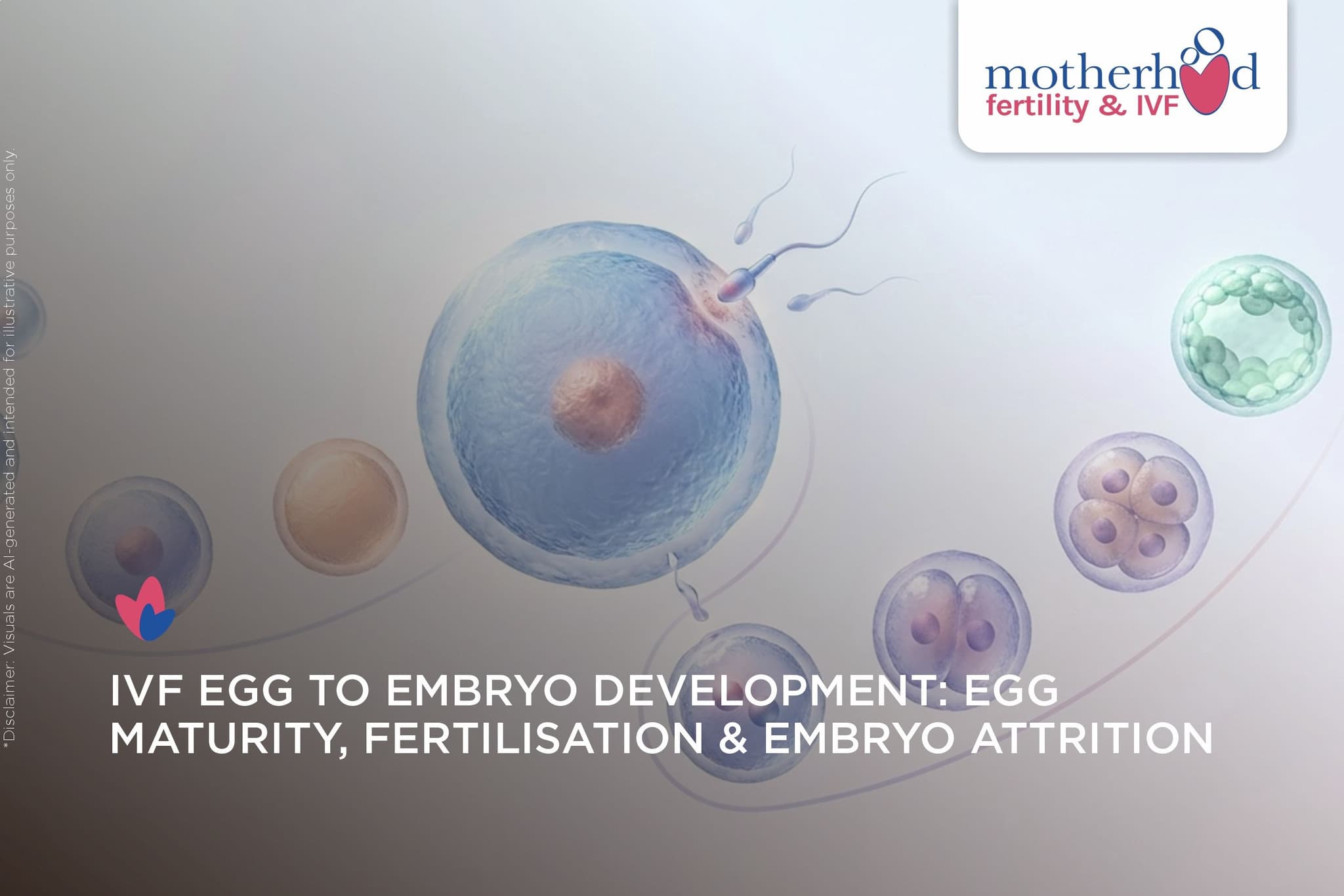

Not all retrieved eggs become embryos during IVF because each egg must pass through several developmental stages before reaching the blastocyst stage. Some eggs may be immature, others may not fertilise successfully, and some fertilised eggs may stop developing before Day 5 or Day 6. For example, retrieving 10 eggs does not mean you will receive 10 embryos suitable for transfer or freezing. Understanding how eggs progress through fertilisation and embryo development can help you interpret your IVF results and recognise why both embryo quality and quantity matter.
Does Retrieving 10 Eggs Mean Getting 10 Embryos?
No. The number of eggs retrieved during IVF is not the same as the number of embryos that eventually develop.
During ovarian stimulation, fertility medicines encourage multiple follicles to grow. Doctors then collect eggs from these follicles through an egg retrieval procedure.
However, not every retrieved egg is mature, and not every mature egg fertilises or develops into a blastocyst.
For example, a patient may have 10 eggs retrieved but ultimately develop fewer embryos suitable for transfer or freezing.
This reduction is commonly referred to as embryo attrition, which describes how the number of eggs or embryos decreases across successive laboratory stages.
To understand the collection procedure, explore what happens during IVF egg retrieval.
What Happens to Eggs After IVF Retrieval?
After egg retrieval, embryologists assess the collected eggs and monitor their development through several stages.
Each stage provides important information about fertilisation and embryo development.
Step 1: Checking Egg Maturity
The first consideration is whether the retrieved eggs are mature enough for fertilisation.
Mature eggs have reached a developmental stage that generally allows them to undergo fertilisation.
Some retrieved eggs may still be immature, even when they come from follicles that appeared to be growing appropriately during stimulation.
For intracytoplasmic sperm injection (ICSI), embryologists usually select mature eggs for sperm injection.
The number of mature eggs can therefore be lower than the total number retrieved.
Step 2: Fertilisation of Mature Eggs
The next stage involves fertilisation, when sperm and egg genetic material combine.
Depending on the treatment plan, fertilisation may occur through conventional IVF insemination or ICSI.
Even when an egg is mature, fertilisation is not guaranteed.
Embryologists assess whether fertilisation has occurred normally, usually around the following day.
Some eggs may not fertilise, while others may show abnormal fertilisation patterns.
The number of normally fertilised eggs is therefore often lower than the number of mature eggs.
Step 3: Embryo Development to Day 5
After successful fertilisation, embryos begin dividing into multiple cells.
Embryologists monitor their development over the following days.
Some embryos continue developing normally, while others may slow down or stop dividing.
By approximately Day 5 or Day 6, some embryos reach the blastocyst stage, when they have developed distinct groups of cells involved in further embryonic development.
Not every fertilised egg reaches this stage.
For a broader understanding of the process, read about the different stages of IVF treatment.
Why Do Some Embryos Stop Developing?
Embryo development is a complex biological process influenced by several factors.
Some embryos stop developing because they cannot successfully complete the changes required for continued growth.
Possible contributing factors include:
- Egg quality: Egg characteristics, including age-related changes, can influence developmental potential.
- Sperm factors: Sperm quality and DNA integrity may contribute to fertilisation and subsequent embryo development.
- Chromosomal abnormalities: Some embryos have genetic abnormalities that can interfere with development.
- Laboratory observations: Embryologists assess embryo development under carefully controlled laboratory conditions.
- Individual biological variation: Even within the same IVF cycle, eggs and embryos may develop differently.
An embryo that stops developing does not necessarily indicate a problem with every egg or sperm sample.
Your fertility team can explain the observations made during your particular cycle.
How Many Eggs Are Needed for One Blastocyst?
There is no fixed number of retrieved eggs required to produce one blastocyst.
The proportion of eggs that develop into blastocysts varies between patients and treatment cycles.
Consider this hypothetical example:
IVF Development Stage | Illustrative Number |
Eggs retrieved | 10 |
Mature eggs | 8 |
Normally fertilised eggs | 6 |
Embryos continuing development | 5 |
Blastocysts formed | 2 |
These figures are illustrative only. They are not expected results, standard conversion rates or predictions for an individual IVF cycle.
Some patients may develop more blastocysts from 10 retrieved eggs, while others may develop fewer or none.
Factors such as age, egg and sperm characteristics, fertilisation method and embryo development can influence the final number.
The laboratory report provides a more meaningful understanding of an individual's results than a general numerical expectation.
Does Having Fewer Embryos Mean IVF Will Fail?
No. Having fewer embryos does not automatically mean IVF treatment will be unsuccessful.
A single suitable blastocyst can sometimes result in pregnancy following embryo transfer.
However, pregnancy depends on several factors, including embryo characteristics, uterine conditions and individual reproductive health.
Embryologists assess blastocysts based on developmental features that help guide decisions about transfer or freezing.
A favourable embryo grade does not guarantee normal chromosomes, implantation or pregnancy.
Likewise, embryo grading alone cannot predict every outcome.
The purpose of monitoring embryo development is to identify embryos considered appropriate for the next stage of treatment.
Learn more about blastocyst transfer in IVF and how embryos are assessed before transfer.
Frequently Asked Questions
How many embryos can develop from 10 retrieved eggs?
There is no fixed number. Some eggs may be immature, some may not fertilise, and others may stop developing before the blastocyst stage. The final number varies between individuals and treatment cycles.
Why are some eggs immature after retrieval?
Eggs develop at different rates within ovarian follicles. Some may not have completed maturation when retrieval occurs. This can happen despite careful monitoring of follicle growth during ovarian stimulation.
Can an egg fertilise but fail to become a blastocyst?
Yes. Normal fertilisation does not guarantee continued embryo development. Some fertilised eggs stop dividing before reaching the blastocyst stage because of biological or developmental factors.
Is one good-quality blastocyst enough for pregnancy?
One suitable blastocyst can result in pregnancy, but success is not guaranteed. Pregnancy outcomes depend on several factors, including embryo characteristics, age and individual reproductive health.
Does retrieving more eggs always mean better IVF results?
Not necessarily. Retrieving more eggs may provide additional opportunities for fertilisation and embryo development, but egg maturity, embryo quality and individual clinical factors remain important.